
01: Let Yourself Keep Changing
You Are Not Supposed to Remain the Person You Are Today
Growth does not always look like becoming more certain about who you are. Sometimes it looks like realizing that an old version of you no longer fits.
Your interests can change. Your beliefs can change. Your priorities, relationships, boundaries, goals, and spiritual practices can all evolve as you gain new experiences and understand yourself differently.
Identity is not completely fixed. Research on adult development and identity shows that people continue changing throughout life, influenced by experience, relationships, culture, and the choices they make.
You do not have to keep being who you were simply because that version of you once made sense.
READ THIS ✦
How Our Identity Changes Throughout Our Life
Psychology Today explores how identity continues evolving throughout adulthood and how life experiences can reshape the way we answer the question, “Who am I?” It also discusses why letting go of parts of an old identity can feel uncomfortable even when change is leading somewhere more meaningful.
→ Read the Article
DO THIS NOW ✦
Step 1: Notice What Has Already Changed
Think about who you were one year ago, five years ago, or even ten years ago.
Write down a few things that are different now: what you believe, what you tolerate, what matters to you, what you want, or how you see yourself.
Step 2: Notice What No Longer Fits
Ask yourself:
“What am I still carrying simply because it used to be part of who I was?”
It could be a belief, identity, habit, goal, relationship dynamic, expectation, or label.
Step 3: Give Yourself Permission to Evolve
Finish this sentence:
“I am allowed to become someone who…”
Write whatever comes naturally without worrying whether it matches the person you used to be.
BEFORE MOVING ON ✦
Choose one part of yourself that you are ready to let evolve instead of forcing it to remain familiar.
Every change does not erase who you were. It becomes part of the person you are becoming.
02: Follow What Feels Alive
Pay Attention to What Gives You Energy, Curiosity, and a Desire to Keep Exploring
Some interests come and go quickly. Others keep returning. You find yourself reading about them, thinking about them, talking about them, or wanting to understand more even when no one is asking you to.
That pull is worth noticing. Curiosity is a form of intrinsic motivation, the natural desire to learn, explore, and engage with something because the experience itself feels interesting or meaningful. Research on motivation shows that genuine interest can be a powerful reason to continue learning and exploring.
You do not have to know where an interest will lead before following it. Sometimes what makes you feel more awake, engaged, and curious is showing you exactly where your next exploration belongs.
READ THIS ✦
The Seductive Power of Curiosity
The American Psychological Association explores research on curiosity and intrinsic motivation, including why the desire to know something can become powerful enough to motivate us to seek information, try something new, and keep exploring without needing an outside reward.
→ Read the Article
DO THIS NOW ✦
Step 1: Notice What Lights You Up
Think about the last few weeks or months.
Write down the subjects, conversations, experiences, ideas, or activities that made you want to know more.
Do not judge whether they are useful or important yet.
Step 2: Look for the Energy
Choose a few things from your list and ask:
“How do I feel when I explore this?”
Notice what makes you feel engaged, inspired, energized, peaceful, creative, or eager to continue.
Step 3: Follow One Pull
Choose one thing that feels especially alive right now and give yourself permission to explore it further.
Read something. Try something. Learn something. Experience it directly.
You are not committing to a new identity or lifelong path. You are simply following genuine interest long enough to see where it leads.
BEFORE MOVING ON ✦
Choose one interest you want to intentionally follow instead of dismissing it or waiting for a practical reason.
You do not need to know where curiosity is taking you before you begin following it.
03: Experience More Than You Analyze
Some Things Can Only Be Understood by Living Them
Research can teach you a lot, but there comes a point when reading, comparing, and thinking cannot tell you how something will actually feel for you.
You can read about meditation without ever sitting in silence. Learn the meanings of tarot cards without pulling one for yourself. Study intuition without testing what happens when you follow it. Some understanding only becomes available after you move from thinking about an experience to actually having it.
Psychology distinguishes experience from something merely imagined or thought about, and experiential learning emphasizes the role of action followed by reflection.
You do not have to understand everything before you try it. Sometimes the experience is what gives you the understanding.
READ THIS ✦
How to Stop Overthinking and Start Taking Action
Psychology Today explores how overthinking can feel productive while actually keeping you stuck. The article explains why taking small, imperfect action can provide real information, build confidence, and create clarity that thinking alone cannot always provide.
→ Read the Article
DO THIS NOW ✦
Step 1: Choose Something You Have Been Studying
Think of one thing you have spent time reading, watching, or learning about but have not actually experienced for yourself.
Maybe it is meditation, tarot, journaling, astrology, energy work, manifestation, spending time in nature, or something completely different.
Step 2: Try a Small Version
Choose one simple way to experience it directly.
Do not worry about doing it perfectly. Give yourself permission to be a beginner and simply notice what happens.
Step 3: Reflect Afterward
Ask yourself:
What did I notice?
How did it actually feel compared with what I expected?
What did I learn from experiencing it that I could not have learned by reading about it?
BEFORE MOVING ON ✦
Choose one thing you have been analyzing and experience it instead.
You do not have to think your way into every answer. Sometimes you have to live your way into it.
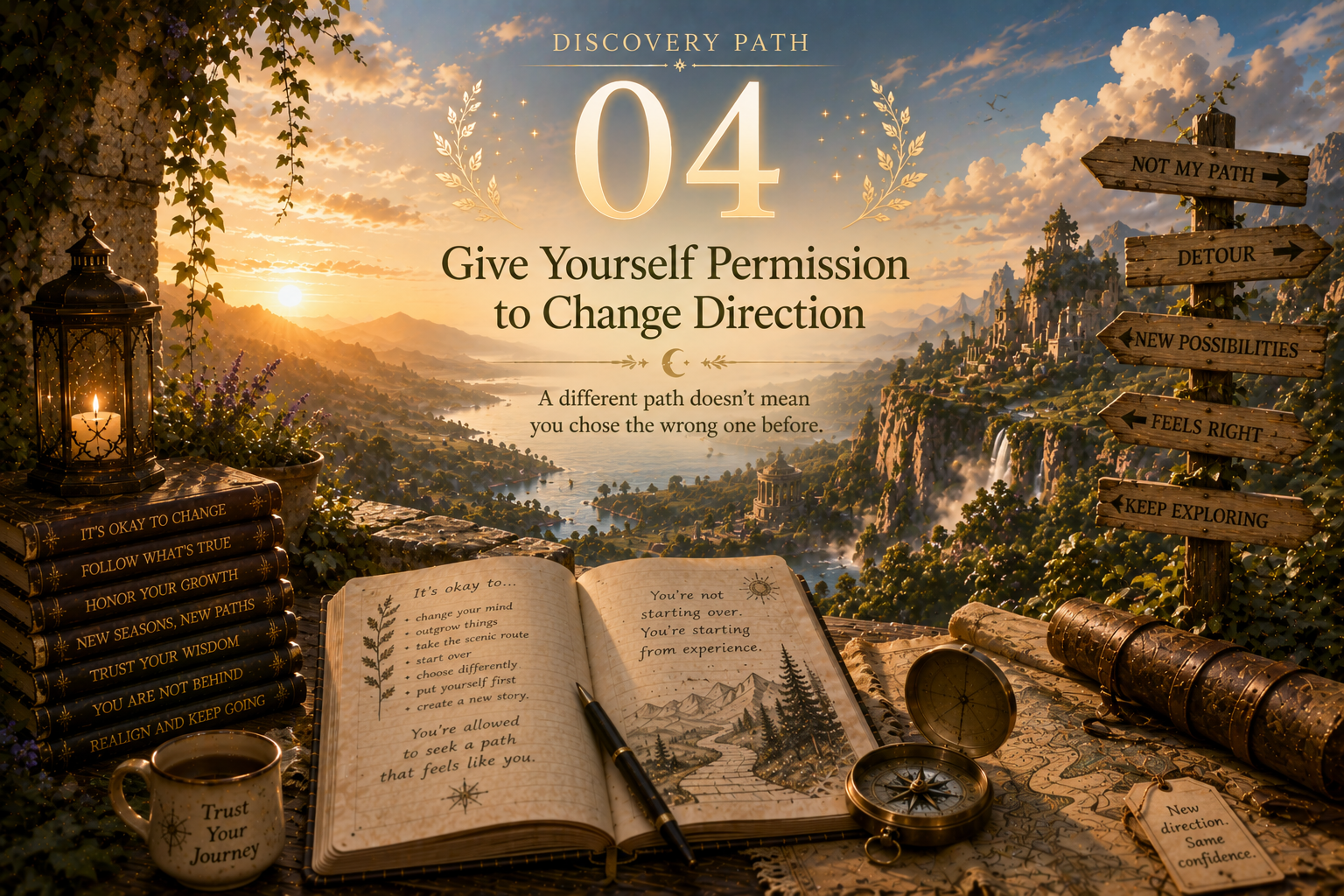
04: Give Yourself Permission to Change Direction
A Different Path Doesn’t Mean You Chose the Wrong One Before
Sometimes a path fits you for a season and then stops fitting. A goal, belief, practice, relationship, or direction that once felt right can begin to feel limiting, uninteresting, or disconnected from who you are becoming.
Changing direction does not automatically mean you failed or made a bad decision. Sometimes the experience gave you exactly what you needed to learn before showing you that it was time to move differently.
Psychology research on goals also challenges the idea that persistence is always best. Holding onto something simply because you have already invested time, energy, or effort can keep you committed long after it has stopped serving you.
You are allowed to make a new choice with the information and self-awareness you have now.
READ THIS ✦
What to Do When Your Goals Don’t Fit Anymore
Psychology Today explores why people often stay attached to outdated goals because of past effort, outside expectations, or fear of uncertainty. It also explains why recognizing that something no longer fits can be a sign of growth rather than failure.
→ Read the Article
DO THIS NOW ✦
Step 1: Name What No Longer Fits
Think about one direction, goal, belief, or commitment you have been questioning.
Ask yourself:
“If I were choosing this for the first time today, would I still choose it?”
Notice your immediate answer.
Step 2: Separate the Past From the Future
Write down what this path has already given you.
Then ask:
“Am I continuing because this still feels right, or because I have already invested so much in it?”
Your past effort can still have value even if you decide not to continue.
Step 3: Consider a New Direction
Ask yourself:
“What would I explore if I knew changing my mind did not mean I had failed?”
You do not need to make a dramatic change today. Identify one small step that would move you closer to what feels more aligned now.
BEFORE MOVING ON ✦
Give yourself permission to reconsider one choice without judging the version of you who made it.
You are not starting over. You are starting again with more experience, more information, and a clearer understanding of yourself.
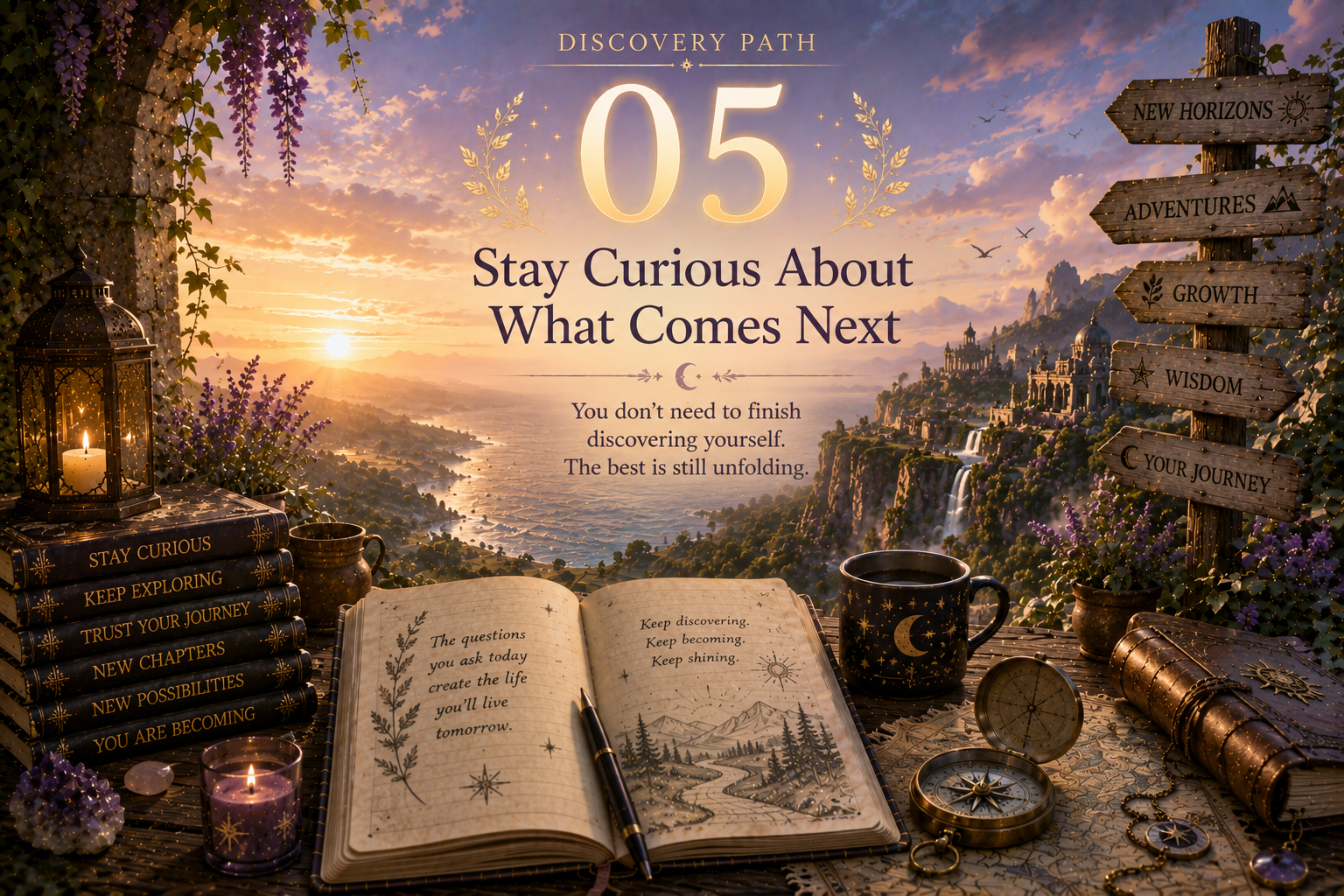
05: Stay Curious About What Comes Next
You Don’t Need to Finish Discovering Yourself
There is no final version of you waiting at the end of this path. New experiences will change what interests you. New relationships may change what you value. Something that means very little to you today may become deeply important years from now.
Discovery is not something you complete. It is something you continue. Research on learning across adulthood shows that people remain capable of developing new skills, interests, and ways of understanding themselves throughout life. Curiosity itself can continue motivating learning and exploration as we age.
You do not need to know what your next chapter will contain. Stay open enough to notice when something new begins calling your attention.
READ THIS ✦
You Can Learn New Things at Any Age
In this episode of the American Psychological Association’s Speaking of Psychology, psychologist Rachel Wu discusses lifelong learning, why adults remain capable of learning new things, and how continuing to explore unfamiliar skills and interests can support growth throughout adulthood.
→ Listen to the Podcast
DO THIS NOW ✦
Step 1: Look Beyond What Interests You Today
Think about something you are curious about now that you never expected to care about a few years ago.
Write down what changed and what opened the door to that interest.
Step 2: Create a “Someday” List
Write down a few things you might want to explore someday.
They can be places, practices, subjects, experiences, skills, or questions.
You do not need to pursue them now. You are simply leaving yourself possibilities.
Step 3: Keep One Question Open
Finish this sentence:
“I wonder what I’ll discover about myself when…”
Let yourself answer without trying to predict exactly where your life is going.
BEFORE MOVING ON ✦
Keep one new experience, question, or possibility on your horizon.
You do not need to have your entire journey mapped out. The questions you ask today may create the life you will discover tomorrow.