
01 Create Space to Notice
Intuition Is Easier to Hear When Everything Else Gets Quieter
Intuition can be difficult to recognize when your attention is constantly being pulled in different directions. Between notifications, conversations, responsibilities, other people’s opinions, and the nonstop stream of thoughts running through your own mind, subtle internal signals may not have much room to get through.
Strengthening intuition does not necessarily mean making it louder. Sometimes it means creating enough quiet to notice what was already there. Before reaching for your phone, asking someone else what they think, or searching for an answer, give yourself a few seconds to notice your own first response.
You may also begin noticing that certain environments make it easier to hear yourself. Your thoughts might become clearer while driving, showering, walking outside, journaling, listening to music, sitting near water, or lying in bed before falling asleep. Pay attention to those moments. They can teach you what conditions help you hear yourself most clearly.
LISTEN TO THIS ✦
The Science of Trusting Your Intuition
UC Berkeley’s Greater Good Science Center explores intuition and includes a simple practice for becoming still, noticing bodily sensations, asking yourself a question, and observing what arises before immediately searching for an outside answer.
→ Listen to the Episode
DO THIS NOW ✦
Step 1: Create Two Minutes of Quiet
Choose one moment today when you can remove distractions for two minutes.
Put down your phone, turn off the television or music, and simply sit, walk, or breathe without trying to accomplish anything.
Step 2: Ask One Simple Question
Think of a small decision or question you have been considering.
Before analyzing it, ask yourself:
What was my first response?
What did I notice in my body?
Did anything feel open, heavy, calm, tense, or clear?
Step 3: Notice Where You Hear Yourself Best
Write down one place or activity where your thoughts naturally become quieter.
That may be one of the environments where your intuitive signals are easiest for you to notice.
01: Create Space to Notice
Intuition Is Easier to Hear When Everything Else Gets Quieter
Intuition can be difficult to recognize when your mind is crowded with opinions, expectations, notifications, worries, and constant information. When everything is demanding your attention at once, your own quieter responses can get buried underneath the noise.
Creating space does not mean you need hours of meditation or complete silence. Even a few intentional minutes without outside input can make it easier to notice what is happening inside you. Psychology research on attention and self-awareness shows that people differ in how accurately they notice internal signals, and focused attention can make those signals easier to recognize.
You are not trying to force intuition to appear. You are creating enough quiet to notice what may already be there.
READ THIS ✦
Is It Intuition or Anxiety?
Psychology Today explains how mental noise and anxious thought loops can make inner signals harder to interpret. It recommends practices such as journaling, reflection, and quiet time to help people notice patterns and better distinguish intuitive responses from anxious thinking.
→ Read the Article
DO THIS NOW ✦
Step 1: Remove the Input
Set aside five quiet minutes without your phone, music, readings, social media, or anyone else’s opinion.
Sit somewhere comfortable and let things become a little quieter.
Step 2: Notice Before You Analyze
Bring one question or situation to mind.
Ask yourself:
“What do I notice first?”
It might be a feeling, image, physical sensation, word, memory, or immediate yes/no response.
Do not decide what it means yet.
Step 3: Write It Down
Record what came up before you start analyzing it.
Then ask:
“Did this feel calm and clear, or urgent and fear-driven?”
Over time, keeping track of these moments can help you recognize your own patterns more easily.
BEFORE MOVING ON ✦
Create one intentional quiet moment each day and notice what appears before you reach for outside input.
The goal is not to make intuition louder. It is to make enough space that you can finally hear it.
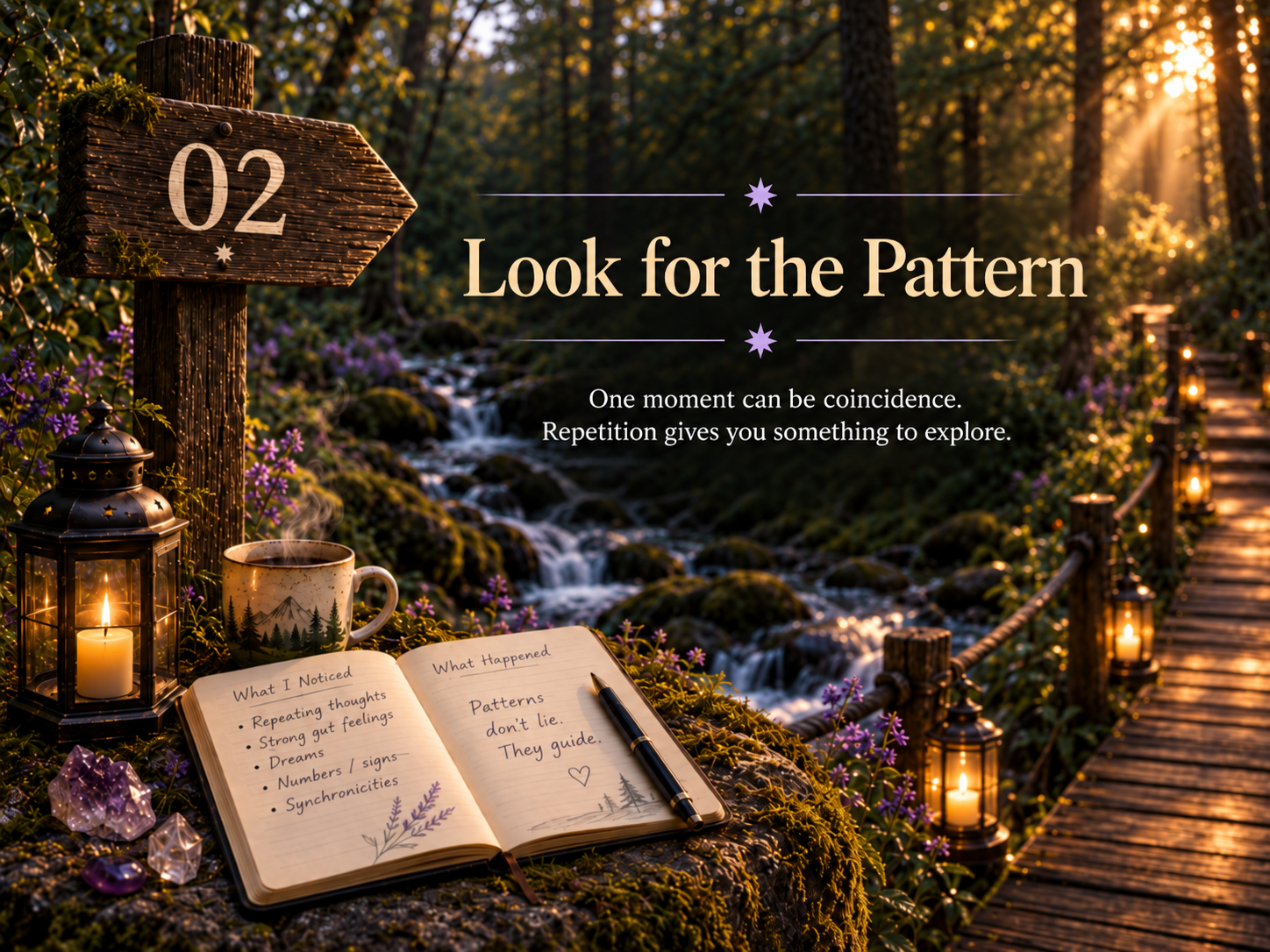
02: Look for the Pattern
One Moment Can Be Coincidence. Repetition Gives You Something to Explore.
Not every thought, feeling, dream, number, symbol, or coincidence needs to mean something. When you begin paying closer attention to intuition, it can become tempting to assign significance to everything you notice.
Instead of focusing too heavily on individual moments, begin watching for patterns. Maybe the same thought keeps returning around a particular decision. Perhaps you consistently feel tense in one situation but calm when imagining another. You might notice similar themes appearing in dreams, conversations, journal entries, or unexpected moments.
Patterns can also help you learn how your own intuition tends to communicate. Your strongest signals might appear as physical sensations, recurring thoughts, dreams, sudden feelings, or something entirely different. Recording what you notice and what happens afterward can help you distinguish meaningful patterns from moments that simply caught your attention.
Psychological research also shows that humans naturally search for patterns, even when events may actually be unrelated. That is why observation matters more than immediately deciding what something means.
The goal is not to search constantly for signs. It is to notice what naturally keeps returning.
READ THIS ✦
When Intuition Misfires
The American Psychological Association explores our natural tendency to recognize patterns and connections, including times when we may see meaning in events that are actually unrelated. It is a useful reminder to remain curious about intuitive patterns without treating every coincidence as proof of something larger.
→ Read the Article
DO THIS NOW ✦
Step 1: Start a Pattern Log
For the next several days, write down anything that naturally catches your attention more than once.
It might be a recurring feeling, thought, dream, situation, number, conversation theme, or intuitive response.
Step 2: Record What Happens Next
Beside each entry, write what was happening when you noticed it and what eventually happened afterward.
Do not interpret it yet. Simply collect the information.
Step 3: Look Back Instead of Looking Harder
After several days or weeks, review what you recorded.
Ask:
“What genuinely repeated?”
“Which things felt important at first but never developed into anything?”
“Are there certain ways my intuition seems to communicate more consistently than others?”
BEFORE MOVING ON ✦
Choose one recurring pattern to continue observing without deciding exactly what it means yet.
Let repetition earn your attention. Then let experience help you understand it.

03: Test It With Small Choices
Build Trust Where the Stakes Are Low
Learning to trust your intuition does not have to begin with major life decisions. In fact, smaller choices can be a much better place to practice because there is less pressure to get everything exactly right.
Try noticing your first response when choosing what to wear, what route to take, when to rest, what you feel like eating, or which task you want to tackle first. Then follow that response and pay attention to what happens.
Practicing with low-stakes decisions gives you a chance to learn what your intuitive signals actually feel like without fear taking over. Psychology Today specifically recommends making small, quick decisions as a way to become more comfortable using intuition and gradually build greater self-trust.
You do not build trust by never getting it wrong. You build it by noticing, choosing, and learning from what happens next.
READ THIS ✦
How to Trust Your Gut Instead of Overthinking
Psychology Today explains why small, low-stakes decisions are a useful way to practice intuition. Starting with simple choices can reduce overwhelm, strengthen self-trust, and make it easier to recognize your own internal signals before using them in bigger decisions.
→ Read the Article
DO THIS NOW ✦
Step 1: Choose Something Small
Pick one decision today that does not have serious consequences.
It might be what to wear, which route to take, what to order, when to take a break, or what you want to do first.
Step 2: Notice Your First Answer
Before comparing options, ask:
“What am I naturally leaning toward?”
Notice the answer before you start talking yourself out of it.
Step 3: Follow It and Check Back
Make the choice, then notice how it felt afterward.
Ask:
“Did following that first response feel natural, uncomfortable, relieving, or completely neutral?”
Keep practicing without expecting every choice to prove anything.
BEFORE MOVING ON ✦
Use your intuition for at least three small choices and pay attention to how your signals feel before and after each one.
Small choices give you a safe place to practice listening before you ask yourself to trust your intuition with something bigger.

04: Let Trust Build Naturally
You Don’t Have to Force Yourself to Believe. Let Experience Show You.
Trusting your intuition does not happen because you decide one day that you should believe every feeling you have. Real trust usually develops more slowly.
You notice something. You follow it. You see what happens. Then you look back and learn from the experience. Over time, those moments begin giving you evidence about which signals tend to be meaningful for you and which ones do not.
That is why intuition becomes easier to trust through experience rather than pressure. Psychology Today notes that intuition can be strengthened and nurtured, especially when it is paired with reflection, knowledge, and lived experience rather than treated as something that must always be right.
You do not need blind faith in yourself. You need enough patience to let experience teach you what deserves your trust.
READ THIS ✦
Trusting Yourself and Your Intuition
Psychology Today explores how self-trust can grow through introspection, experience, and learning to recognize your own internal responses. It also emphasizes that intuition can be useful alongside rational thinking rather than replacing it.
→ Read the Article
DO THIS NOW ✦
Step 1: Look Back at What You’ve Already Learned
Think of a time when you had a strong feeling about something and later understood why.
Write down:
What did I notice first?
What eventually happened?
Step 2: Notice What Built Trust
Ask yourself:
“Was there anything about that experience that helped me recognize the signal more clearly afterward?”
Maybe it was the way the feeling showed up in your body, how calm or persistent it felt, or how often a similar pattern had happened before.
Step 3: Let the Evidence Accumulate
Keep noticing and recording your intuitive responses without demanding that every one of them be correct.
Let repeated experience slowly show you which signals are worth trusting more.
BEFORE MOVING ON ✦
Do not pressure yourself to believe in your intuition more than you genuinely do today.
Trust grows when experience gives you a reason to trust. Let it build naturally.

05: Integrate What You Learn
Let Each Experience Shape a More Intuitive You
Strengthening your intuition is not only about noticing more signals. It is also about learning from what happens after you notice them.
Each time you follow an instinct, record a pattern, make a small intuitive choice, or realize that a feeling was actually anxiety, you gain information about yourself. The important part is looking back and asking what the experience taught you.
Research on intuition suggests that intuitive judgment becomes more reliable when people have repeated experience and feedback that allows them to learn whether their impressions were accurate.
Over time, you may begin recognizing which sensations usually signal hesitation, which feelings tend to appear when something genuinely fits, and which thoughts are simply fear or overthinking.
You are not trying to become perfectly intuitive. You are learning your own intuitive language through experience.
READ THIS ✦
When Should You Trust Your Gut? Here’s What the Science Says
Psychology Today explores research on intuition and pattern recognition, including why experience alone is not enough. Reliable intuition develops when you have opportunities to practice, observe the outcome, and adjust what you have learned from previous experiences.
→ Read the Article
DO THIS NOW ✦
Step 1: Look Back
Think about several intuitive moments you have noticed recently.
Choose one that turned out to be meaningful and one that did not.
Step 2: Compare the Signals
Ask yourself:
“How did each one feel when it first appeared?”
Notice the differences. Was one calm and persistent while the other felt urgent? Did one keep returning while the other disappeared quickly?
Step 3: Write Down What You Learned
Finish these sentences:
“My intuition seems strongest when…”
“I tend to second-guess myself when…”
“A signal I want to pay more attention to is…”
Keep adding to these observations as you gain more experience.
BEFORE MOVING ON ✦
Look back at what you have learned throughout this step instead of measuring yourself by whether every intuitive feeling was correct.
Notice. Test. Reflect. Adjust. Every experience teaches you a little more about how your intuition speaks to you.