
01: The Before You Look Exercise
Make Your Prediction Before the Answer Appears
One of the simplest ways to practice recognizing intuition is to give yourself opportunities to notice what comes to mind before you already know the answer. There is no pressure, no major decision involved, and nothing happens if you are completely wrong. You are simply practicing the habit of noticing your first response before outside information replaces it.
Throughout your day, look for small moments when an answer is about to be revealed. Before checking who sent a text, pause and notice whose name comes to mind. Before looking at the weather, guess whether it will be warmer or cooler than yesterday. When your phone rings, notice who you think it might be before looking at the screen. You can even choose a color, number, or simple image in your mind before turning over a playing card or revealing something you have placed facedown.
Do not try to force the correct answer. The important part is creating a small space between what comes to you first and what you discover afterward. If you are right, notice it. If you are wrong, notice that too. Neither result needs to mean anything by itself.
Keeping track matters because memory can become selective. It is easy to remember the surprising times you guessed correctly and forget all the times you did not. Writing your prediction down first gives you something concrete to compare with the actual result.
Psychology Today describes a similar practice as making a “shadow decision”: recording your immediate instinct before checking recommendations or outside information, then tracking what happens so you can gradually calibrate your intuition.
You are not trying to prove that every first impression is intuitive. You are learning what your first impressions actually feel like.
READ THIS ✦
The Data Within
Psychology Today explores intuition as a form of pattern recognition and recommends practicing with predictions made before outside information is revealed. Comparing those instincts with real outcomes can help you learn when your intuition is useful and when it may simply be a guess.
→ Read the Article
DO THIS NOW ✦
Step 1: Choose Five Before-You-Look Moments
Throughout the day, find five situations where an answer is about to be revealed.
Before you look, write down your first prediction.
Step 2: Record What Actually Happened
Beside each prediction, write the real answer.
Do not change what you originally wrote, even if you immediately start doubting it.
Step 3: Notice How the Prediction Felt
Ask yourself:
“Did this feel like a random guess, or did something arrive quickly and clearly?”
You might notice a word, image, physical sensation, sudden thought, or quiet sense of knowing.
BEFORE MOVING ON ✦
Practice this exercise several times without worrying about your accuracy.
The goal is not to prove your intuition. It is to become familiar with what happens inside you before the answer appears.
02: The Yes or No Exercise
Learn What a Simple Yes and No Feel Like Inside You
Intuition does not always arrive as a clear thought or dramatic feeling. Sometimes it shows up as a subtle sense of opening or closing, comfort or resistance, leaning toward something or pulling away from it.
This exercise helps you become familiar with those differences by starting with questions where you already know the answer. Instead of trying to predict anything, you are paying attention to how your body and mind respond when something is clearly true versus clearly false.
Psychology uses the term interoception for awareness of internal bodily signals such as heartbeat, breathing, tension, and other physical sensations. Those signals can influence emotion and decision-making, which is one reason learning to notice your internal responses can be useful when exploring intuition.
You are not trying to create a perfect yes or no signal. You are learning how your own responses tend to feel.
READ THIS ✦
Feel It Out or Think It Over: How Body Signals Guide Choices
Psychology Today explores how internal body signals can influence emotions and decisions. It also explains why those signals need context and should not automatically be treated as correct, making it a useful foundation for learning how your own intuitive responses feel.
→ Read the Article
DO THIS NOW ✦
Step 1: Start With an Obvious Yes
Sit somewhere comfortable and take a moment to settle.
Say something about yourself that you know is completely true, such as:
“My name is ____.”
Pause and notice what happens inside you.
Step 2: Try an Obvious No
Now say something you know is false.
For example:
“My name is someone completely different.”
Again, pause and notice your response.
Step 3: Compare the Difference
Ask yourself:
“What did yes feel like?”
“What did no feel like?”
You may notice changes in your chest, stomach, breathing, posture, thoughts, or overall sense of ease or resistance.
Repeat the exercise with several simple facts so you are not relying on one experience.
BEFORE MOVING ON ✦
Write down any differences you consistently notice between your yes and no responses.
Your signals may be subtle. The goal is not to force them to become stronger. It is to become more familiar with what is already there.
03: The Two Choices Exercise
Notice Where Your Attention Naturally Wants to Go
When you are choosing between two options, your mind can quickly turn even a simple decision into a debate. You start comparing advantages, imagining outcomes, remembering what other people have said, and trying to determine which choice makes the most sense.
This exercise temporarily removes all of that analysis so you can practice noticing what happens before your thoughts take over.
Choose two options that do not carry much emotional weight. They might be two restaurants, two movies, two places to walk, two outfits, two activities, or two things you could make for dinner. Write each option on a separate piece of paper, fold them so you cannot see the words, mix them up, and place one in each hand.
Then pause.
Notice whether your attention naturally settles on one hand. Does one option feel lighter, calmer, more interesting, or simply more appealing? You may not feel anything dramatic at all. That is okay. The point is to notice your first response before you begin reasoning through the decision.
Research on intuitive decision-making suggests that gut choices can feel easier and more personally aligned in familiar, low-stakes situations. Intuition is not automatically more accurate, but practicing with simple choices gives you a safer way to become familiar with how your own preferences and internal signals show up.
You are not trying to prove that your first pull is always right. You are practicing noticing where your attention goes before analysis changes it.
READ THIS ✦
Going With Your Gut Feels Good, but It’s Not Always Wise
Psyche explores research on intuitive versus deliberate decision-making. It explains that intuitive choices can feel easier and more aligned with personal preferences, especially in familiar, everyday decisions, while also emphasizing that some situations still require careful analysis.
→ Read the Article
DO THIS NOW ✦
Step 1: Choose Two Low-Stakes Options
Pick two choices where either outcome would be completely fine.
Write each one on a separate piece of paper and fold them.
Step 2: Notice Before You Think
Mix the papers and place one in each hand.
Pause and ask:
“Which one am I naturally drawn toward?”
Notice your first response without trying to explain it.
Step 3: Reveal and Reflect
Open the paper you felt drawn toward.
Ask yourself:
“How did that pull feel before I knew what I was choosing?”
Repeat the exercise with several different pairs so you can begin noticing whether any consistent signals emerge.
BEFORE MOVING ON ✦
Try the exercise at least three times with simple choices.
The goal is not to make every decision intuitively. It is to recognize what your natural pull feels like before your mind starts building a case for either option.
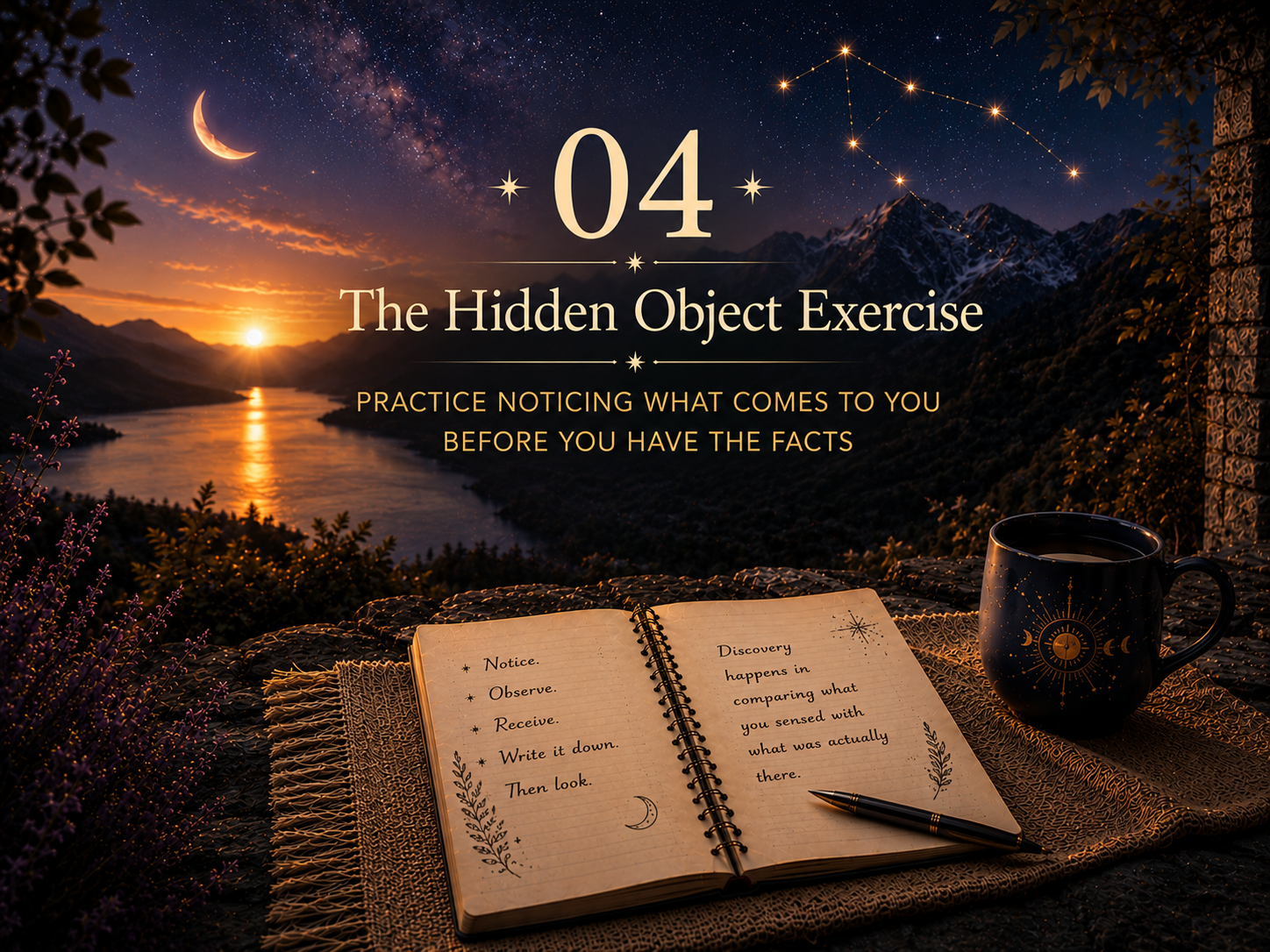
04: The Hidden Object Exercise
Practice Noticing What Comes to You Before You Have the Facts
This exercise gives you a simple way to practice receiving an impression when you genuinely don’t know the answer. Instead of trying to predict something that is about to happen, you’ll focus on an object you can’t see and pay attention to whatever information naturally comes to mind.
The goal isn’t to identify the object perfectly. It is to notice how your mind and body respond when you are working without the information you normally rely on.
Have someone place a familiar object inside an opaque bag, box, or envelope without telling you what it is. Before opening it, get quiet and notice your first impressions. A color may come to mind. You might picture a shape, think of a texture, notice a word, or simply feel that the object is heavy, light, soft, hard, natural, or manufactured.
Write everything down before you look. Avoid trying to turn the impressions into a specific answer. If you notice “cold, smooth, silver,” record exactly that instead of immediately deciding the object must be a spoon.
Psychologists have studied how people can learn and process information without being consciously aware of every step involved. Intuition can sometimes reflect rapid associations and knowledge that surface before conscious reasoning catches up, but those impressions are not automatically accurate.
Discovery happens in comparing what you sensed with what was actually there.
READ THIS ✦
What We Know Without Knowing How
The American Psychological Association explores research into intuition and unconscious learning, including how people can absorb patterns and information without being able to explain exactly how they learned them. It also emphasizes that intuitive impressions can sometimes be useful and sometimes misleading, which is why testing them against actual outcomes matters.
→ Read the Article
DO THIS NOW ✦
Step 1: Hide the Object
Have someone choose a simple household object and place it somewhere you cannot see it.
Make sure they do not give you hints about what they chose.
Step 2: Record Your Impressions
Before looking, pause for a minute and write down whatever arrives naturally.
Notice things like color, shape, texture, weight, temperature, material, an image, a word, or a physical sensation.
Do not force an answer. Record what comes up even if it seems random.
Step 3: Reveal and Compare
Look at the object and compare it with what you wrote.
Ask:
“Which impressions matched?”
“Which ones didn’t?”
“Did anything come through clearly before I started guessing?”
Repeat the exercise with different objects and look for patterns across multiple attempts rather than judging yourself from one result.
BEFORE MOVING ON ✦
Try the Hidden Object Exercise several times and keep your original notes so you can compare them honestly.
You are not trying to prove that every impression means something. You are learning how information seems to arrive for you when the answer is still unknown.
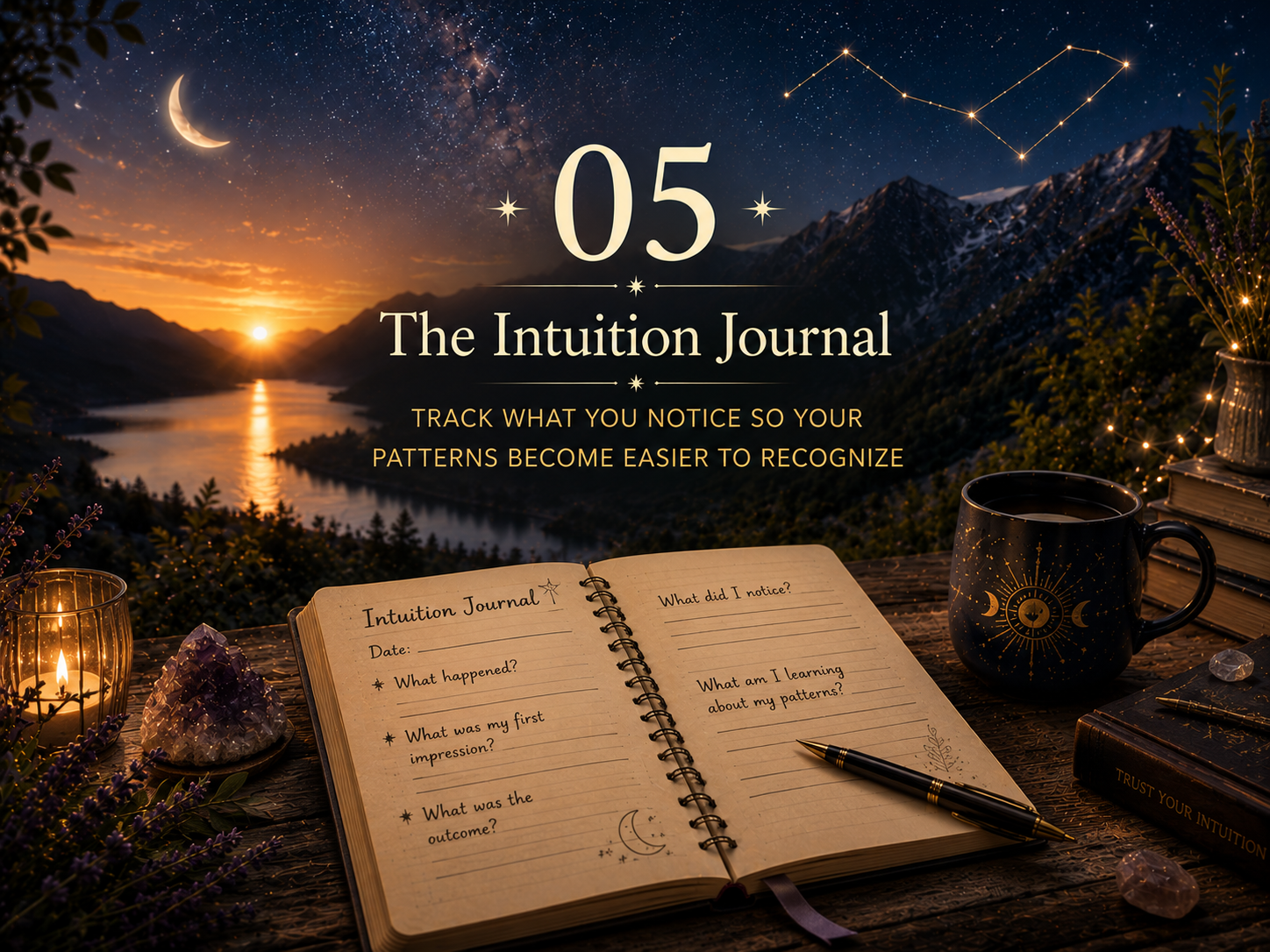
05: The Intuition Journal
Track What You Notice So Your Patterns Become Easier to Recognize
One of the best ways to strengthen your intuition is surprisingly simple: start keeping track of it. A feeling that seems important today can be difficult to remember accurately weeks later, especially once you already know how the situation turned out.
An intuition journal gives you a record of what you actually noticed before you knew the outcome. Write down the situation, your first impression, any physical sensations or thoughts that came with it, and what eventually happened. Over time, you can begin comparing those experiences instead of relying on memory alone.
Journaling can also support self-awareness and reflection. Looking back through what you have written can reveal recurring thoughts, emotional responses, and patterns that were much harder to recognize while you were experiencing them.
The goal is not to create a record of every time you were “right.” Record the misses too. Those are just as valuable because they help you recognize when fear, expectation, coincidence, or wishful thinking may have influenced what you felt.
Your journal becomes useful when it shows you the whole pattern, not just the moments you want to remember.
READ THIS ✦
How to Start Journaling for Better Mental Health
Psychology Today explains how journaling can support reflection and self-awareness and recommends periodically reviewing older entries to notice changes and patterns you may not recognize in the moment.
→ Read the Article
DO THIS NOW ✦
Step 1: Record the Moment
Whenever something feels intuitive, write down:
What happened?
What was my first impression?
What did I notice in my body or emotions?
Do this before you know how the situation turns out whenever possible.
Step 2: Add the Outcome Later
Come back to the entry once you have more information.
Write:
“What actually happened?”
Do not change your original notes to make them fit the outcome.
Step 3: Review for Patterns
Every few weeks, read through your entries and ask:
“Which signals seem to repeat?”
“Which impressions were useful?”
“Which ones seemed connected to fear, expectation, or overthinking?”
“What am I learning about the way my intuition tends to show up?”
BEFORE MOVING ON ✦
Keep your intuition journal long enough to collect several experiences before drawing conclusions.
You are not keeping score. You are gathering evidence about yourself, one experience at a time.