
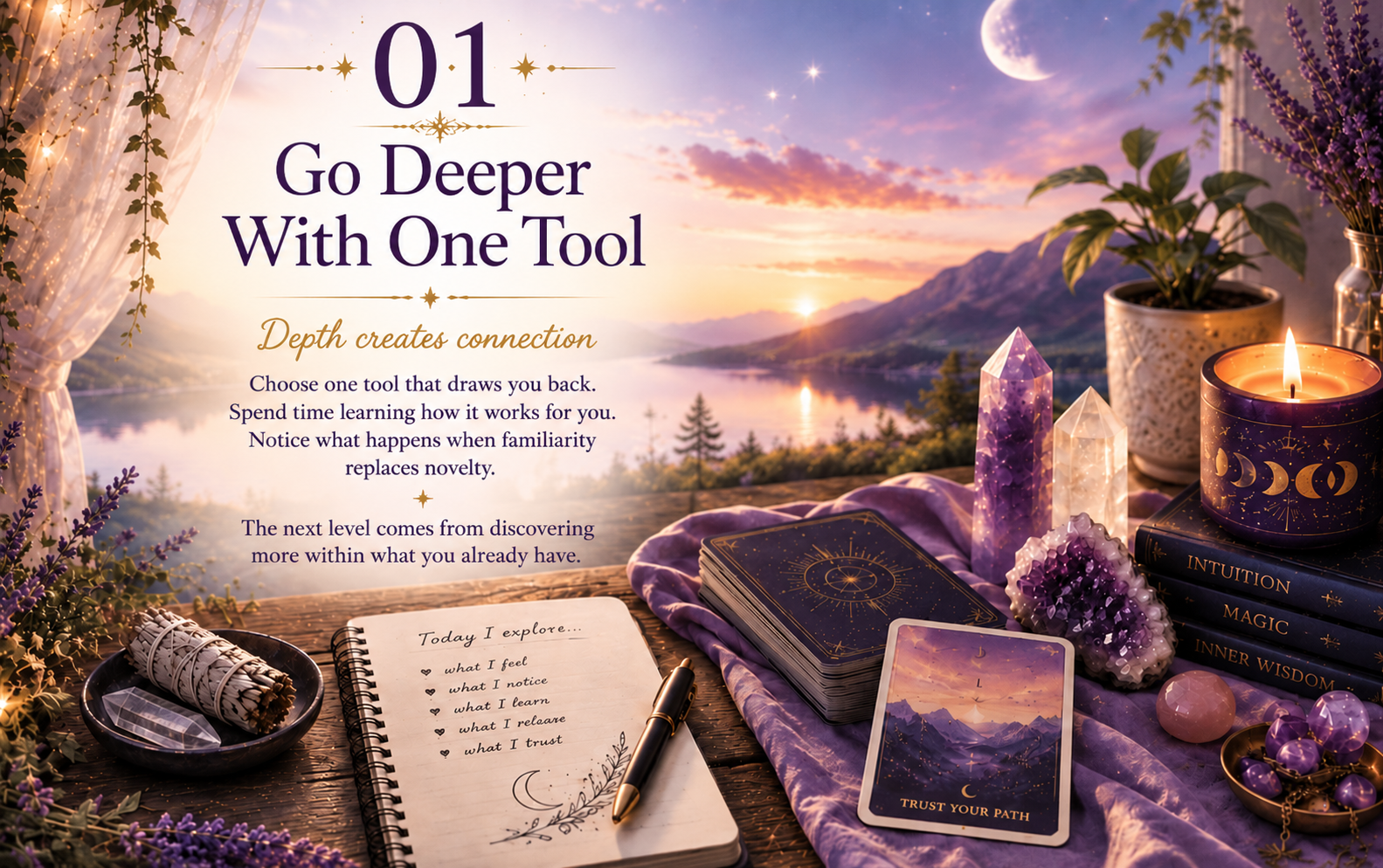
01: Go Deeper With One Tool
Depth Creates Connection
You’ve explored different spiritual tools and started discovering what feels meaningful to you. Now, instead of adding more, this step is about choosing one tool and giving yourself enough time to understand it more deeply.
Familiarity can change the way you experience a practice. The more time you spend with one tarot deck, meditation style, crystal practice, pendulum, journal method, or other tool, the more you begin noticing details you may have missed when everything was new.
Going deeper does not mean committing to one tool forever. It simply means staying with something long enough to move past the excitement of discovering it and begin learning how it actually works for you.
READ THIS ✦
Practice for Knowledge Acquisition: Not Drill and Kill
The American Psychological Association explains how deliberate practice uses attention, repetition, reflection, and purposeful learning to build deeper knowledge and skill over time. While the article focuses on learning generally, the same idea can help you approach a spiritual tool with curiosity and depth instead of constantly moving on to the next new thing.
→ Read the Article
DO THIS NOW ✦
Step 1: Choose the Tool That Keeps Drawing You Back
Look at the tools you’ve explored so far and choose one you genuinely want to understand better. Pick the one you find yourself returning to, thinking about, or wanting to learn more about.
Step 2: Learn One Layer Deeper
Choose one specific thing to learn instead of trying to master everything at once. If you choose tarot, study a few cards or one simple spread. If you choose crystals, learn more about a few stones you already own. If you choose meditation, practice one technique consistently. If you choose a pendulum, learn one clear method for working with it.
Step 3: Explore It for One Week
Use your chosen tool several times over the next seven days. Keep a few notes about what you notice: What feels natural? What confuses me? What am I learning? What do I want to understand next? What am I beginning to trust through experience?
BEFORE MOVING ON ✦
Choose one spiritual tool you want to understand beyond the beginner level and spend enough time with it to discover something you would not have noticed when it was still completely new.

02: Learn Your Own Language
Notice How Guidance Speaks to You
As you spend more time with one spiritual tool, you may begin noticing that certain feelings, symbols, thoughts, or physical sensations show up repeatedly. This is where your practice can start becoming more personal.
Guidance does not necessarily feel the same for everyone. You might notice a calm sense of knowing, a physical reaction, a word or image that suddenly comes to mind, a symbol that repeatedly catches your attention, or a particular feeling when something resonates.
The goal is not to treat every thought or coincidence as a message. It is to pay attention to what repeatedly feels meaningful and learn how your own inner responses tend to communicate with you.
READ THIS ✦
The Science of Intuition
Psychology Today explores how intuition can draw on unconscious pattern recognition and internal body signals. It explains why intuitive information may appear as physical sensations, feelings, images, words, or a sense of knowing before you consciously understand where it came from.
→ Read the Article
DO THIS NOW ✦
Step 1: Notice What Shows Up First
For the next several times you use your chosen tool, pause before looking up meanings or interpretations. Write down what appears first. It might be a feeling, body sensation, word, image, memory, symbol, or immediate thought.
Step 2: Track What Repeats
Keep a simple record for one week. Notice whether certain types of signals show up again and again. Maybe clarity feels calm in your body. Maybe hesitation feels heavy. Maybe certain symbols consistently make you think about the same theme.
Step 3: Build Your Personal Language
At the end of the week, write down three patterns you noticed and what they seem to mean for you. Keep these as observations, not permanent rules. Your understanding can change as you gain more experience.
BEFORE MOVING ON ✦
Be able to identify at least one or two ways your own inner guidance tends to get your attention. You are not memorizing someone else’s spiritual language. You are beginning to recognize your own.
03: Practice Discernment
Not Everything Is a Sign
As you deepen your spiritual practice, you may become more aware of coincidences, repeating numbers, symbols, dreams, intuitive feelings, or moments that seem unusually meaningful.
Some of those experiences may feel important to you, and it is okay to explore that meaning. Discernment means staying curious without automatically assuming that everything you notice is guidance. Our minds naturally look for patterns, especially once something has our attention.
A grounded spiritual practice leaves room for both intuition and reality. You can notice something, reflect on what it means to you, and still consider other explanations before making an important decision.
READ THIS ✦
Synchronicity
Psychology Today explores why coincidences and repeating patterns can feel meaningful, how attention and confirmation bias can influence what we notice, and why it can be helpful to balance intuition with common sense and verifiable information when interpreting possible “signs.”
→ Read the Article
DO THIS NOW ✦
Step 1: Notice Without Deciding
The next time something feels like a sign, write down exactly what happened before deciding what it means. Separate the actual event from your interpretation of it.
Step 2: Ask Three Questions
Ask yourself: Why did this stand out to me? Is there another reasonable explanation? Does interpreting this as guidance actually help me understand something about myself or the situation?
Step 3: Check Before You Act
If the message seems to point toward an important decision, pause. Consider your intuition alongside the facts you already have, what you know about the situation, and what the possible consequences could be.
BEFORE MOVING ON ✦
Be able to explore signs, synchronicities, and intuitive experiences without feeling like you have to believe or act on every one of them. Discernment allows you to stay spiritually open while still thinking for yourself.

04: Keep Your Power With You
Let Your Tools Guide You, Not Control You
Spiritual tools can offer reflection, perspective, and a different way of looking at a situation. But the tool is not the one living your life. You are.
A tarot card, pendulum, intuitive feeling, astrology reading, or other spiritual practice can give you something to consider, but it does not have to make your decisions for you. The healthiest way to use spiritual tools is alongside your own judgment, values, experience, and real-world information.
Keeping your power with you means remembering that guidance can support a choice without replacing your ability to choose.
READ THIS ✦
Self-Determination Theory: A Quarter Century of Human Motivation Research
The American Psychological Association explains self-determination theory and the importance of autonomy, which is the feeling that your choices and actions are genuinely your own rather than controlled by outside forces. That idea fits beautifully here: spiritual tools can support your reflection while you remain the person making the decision.
→ Read the Article
DO THIS NOW ✦
Step 1: Notice Where You Give the Tool Too Much Power
Think about how you use your chosen spiritual tool. Have you ever felt like you needed another card, another pendulum answer, another reading, or another “sign” before you could make a decision? Write down one situation where you may have been looking outside yourself for certainty.
Step 2: Bring Yourself Back Into the Decision
Ask yourself: What do I actually want? What do I already know about this situation? What facts or practical information matter here? What choice would I make if I did not have the spiritual tool in front of me?
Step 3: Use the Tool as Reflection
Now use your tool once and ask a question that supports reflection rather than handing over the decision. Instead of “What should I do?” try: “What might I need to consider?” “What am I overlooking?” or “What would help me make this choice with more clarity?”
BEFORE MOVING ON ✦
Be able to use a spiritual tool for guidance without feeling like you have to obey it. Your tools can offer perspective, but the final choice stays with you.

04 Make the Practice Your Own
You Don’t Need to Follow Someone Else’s Rules
Spiritual tools are meant to support you, not give you another set of rules to follow. As you experiment, you may discover that some practices feel natural while others feel forced, confusing, or simply unnecessary. That is useful information.
Your practice can be simple. You might pull a tarot card when you need reflection, journal when your thoughts feel crowded, meditate when you need quiet, or use a ritual only when it carries meaning for you. You do not need to use every tool or practice in the same way someone else does.
The goal is to begin creating something that actually fits your life. Keep what helps you feel more connected, curious, grounded, or aware. Let the rest go.
READ THIS ✦
How Everyday Rituals Can Add Meaning to Your Life
UC Berkeley’s Greater Good Science Center explores how ordinary actions can become meaningful rituals when we give them intention and personal significance. It is a helpful reminder that meaningful practices do not need to be elaborate or follow someone else’s formula.
→ Read the Article
DO THIS NOW ✦
Step 1: Choose What Actually Helps You
Write down three spiritual tools or practices you have explored that genuinely feel useful, interesting, or meaningful to you.
Step 2: Create Your Own Simple Practice
Choose one or two of them and decide how they could naturally fit into your life.
Maybe that means:
Pulling a card once a week
Journaling when you need clarity
Meditating for a few minutes before bed
Creating a small ritual when you need to reset
Step 3: Let Something Go
Choose one practice you have been doing because you think you should.
Give yourself permission to stop, change it, or come back to it later.